
Artificial intelligence reduces the effort required for research, structuring and the development of different formats. This shifts the constraint in marketing: the decisive question is no longer how much content an organization can produce, but whether it has something relevant and distinctive to say.
The real constraint comes before production
When texts, variants and campaign ideas can be created in a short time, production capacity alone no longer provides meaningful differentiation. Value is created earlier: in selecting the right topics, interpreting market change and defining a clear position.
Good marketing therefore does not begin with a prompt. It begins with strategic choices that cannot be delegated to a tool or replaced by more output.
- Which customers and markets really matter?
- Which changes shape their decisions?
- Which problems do we understand through experience?
- What credible contribution can we make?
- What makes our perspective distinctive?
Customer knowledge becomes more valuable, not less
In complex B2B markets, relevance comes from understanding the customer’s situation: priorities, risks, decision paths and economic context. In MedTech, technical, regulatory, clinical and operational requirements add further interdependencies.
AI can synthesize information, reveal patterns and test hypotheses faster. It cannot replace direct dialogue, market experience or the judgment needed to distinguish an interesting signal from a robust customer insight. The easier content becomes to create, the more important the quality of the knowledge behind it becomes.
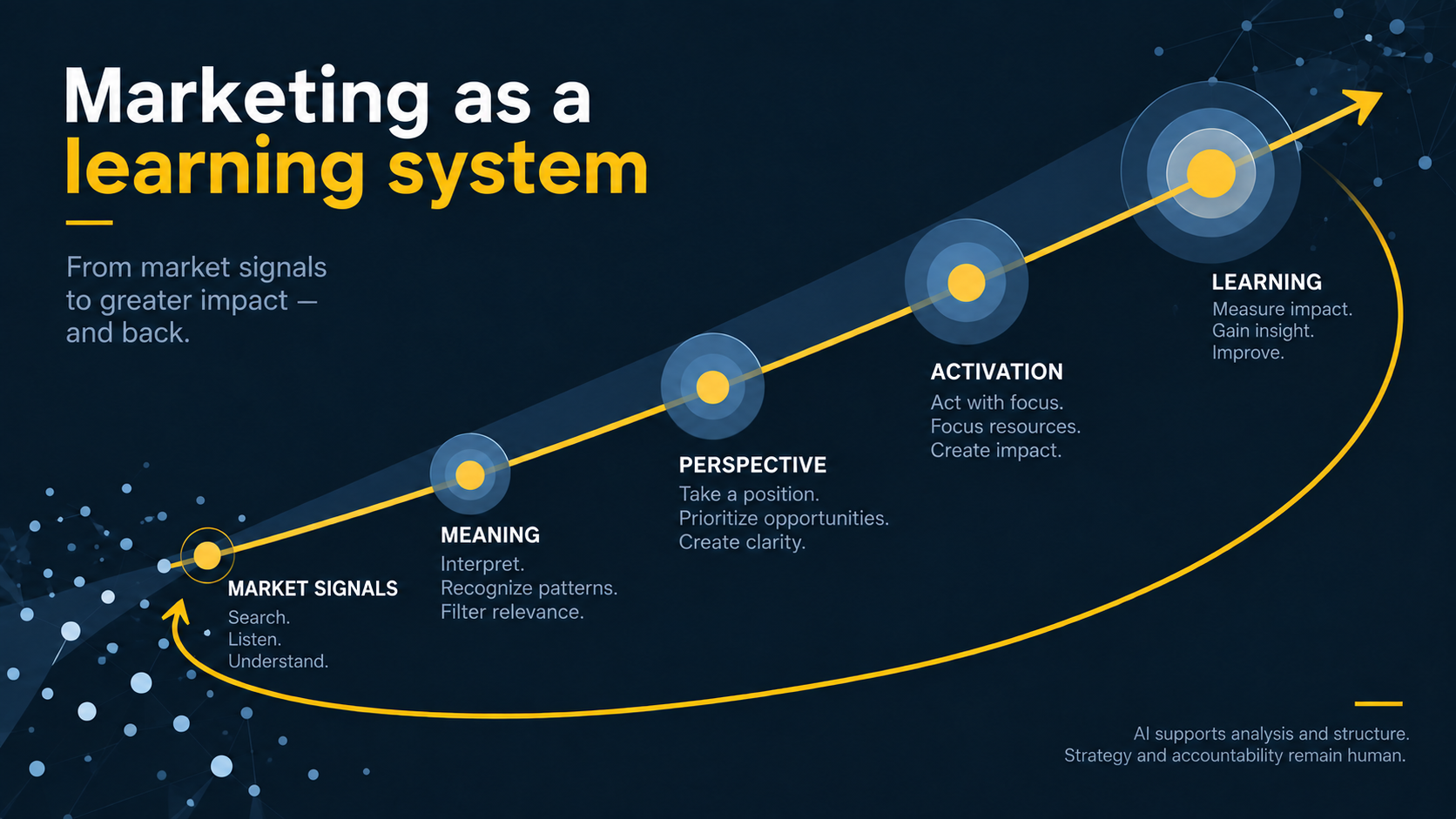
Marketing must operate as a learning system
The strategic value of AI lies not only in faster content production. It lies in a stronger learning cycle: detecting market signals, interpreting their meaning, developing a clear perspective, activating it with purpose and learning from the response.
Seen this way, marketing connects market observation, customer knowledge, positioning and execution. AI can support every step. The system’s direction, however, comes from strategy, experience and accountable decisions.
- Detect signals
- Interpret their meaning
- Develop a clear perspective
- Activate with purpose
- Learn from the response
More output requires stronger editorial leadership
As production speed increases, so does the responsibility for selection and quality. Not everything that can be created should be published. Editorial leadership determines which content advances the positioning, which claims are robust and where confidentiality or approval requirements set boundaries.
This requires clear standards and visible accountability. Leadership is not about writing every sentence. It is about creating a dependable framework for relevance, factual accuracy and a consistent brand voice.
- Factual accuracy and traceable sources
- Consistent positioning and brand voice
- Relevance for the intended audiences
- Protection of confidential information
- Clear approvals and accountability
- The discipline to avoid generic content
AI becomes a test of strategic clarity
When organizations can access comparable tools, technology itself is rarely a durable advantage. Differentiation comes from the choices around it: a precise view of the market, a credible position, relevant customer knowledge and the discipline not to communicate every possible message.
AI can accelerate strong marketing. At the same time, it exposes ambiguity faster. Its use therefore becomes a test: Is the strategic direction clear enough to guide technology with purpose, or is the organization simply producing more of what was already interchangeable?
When content becomes a commodity, the organization with the greatest output will not win. The advantage belongs to the one with the clearest position, the strongest customer understanding and the highest editorial discipline.