
Many MedTech innovations do not fail at the idea or prototype stage, but during the transition to robust serial production. This is where technical possibility must become a medical device that can be supplied reliably and scaled economically. Industrialization is therefore not a downstream production step, but a strategic capability.
The demanding path to the market
A promising idea is not yet a successful medical device. A functional prototype is not yet a reliable series product. And regulatory approval alone does not ensure that a product can be manufactured economically, consistently and at the required scale.
Between product development and routine clinical use lies a complex transition. Material selection, design for manufacturing, validated processes, quality management and regulatory requirements must be brought together. At the same time, companies need to consider scalability, supply-chain resilience, cost structures and long-term availability.
Each of these elements influences the others. A design decision may affect manufacturability. A material choice may influence validation or future sourcing options. A process that performs well at prototype level may become difficult to control when volumes increase. Industrialization therefore cannot begin only after development has been completed. It needs to be considered from the outset.
Designing with series production in mind
In my experience, many later challenges have their origins in the early stages of a project. When development, engineering, manufacturing, quality and regulatory perspectives are connected early, technical dependencies become visible sooner. Teams can evaluate whether tolerances are realistic, processes can be validated and the product can be scaled without compromising performance or quality.
This does not limit innovation. It gives innovation a realistic path to the market. The objective is not simply to manufacture a product once. It is to establish a system capable of producing it repeatedly, reproducibly and economically—potentially for many years and across changing market conditions.
A changing role for OEM and CDMO partners
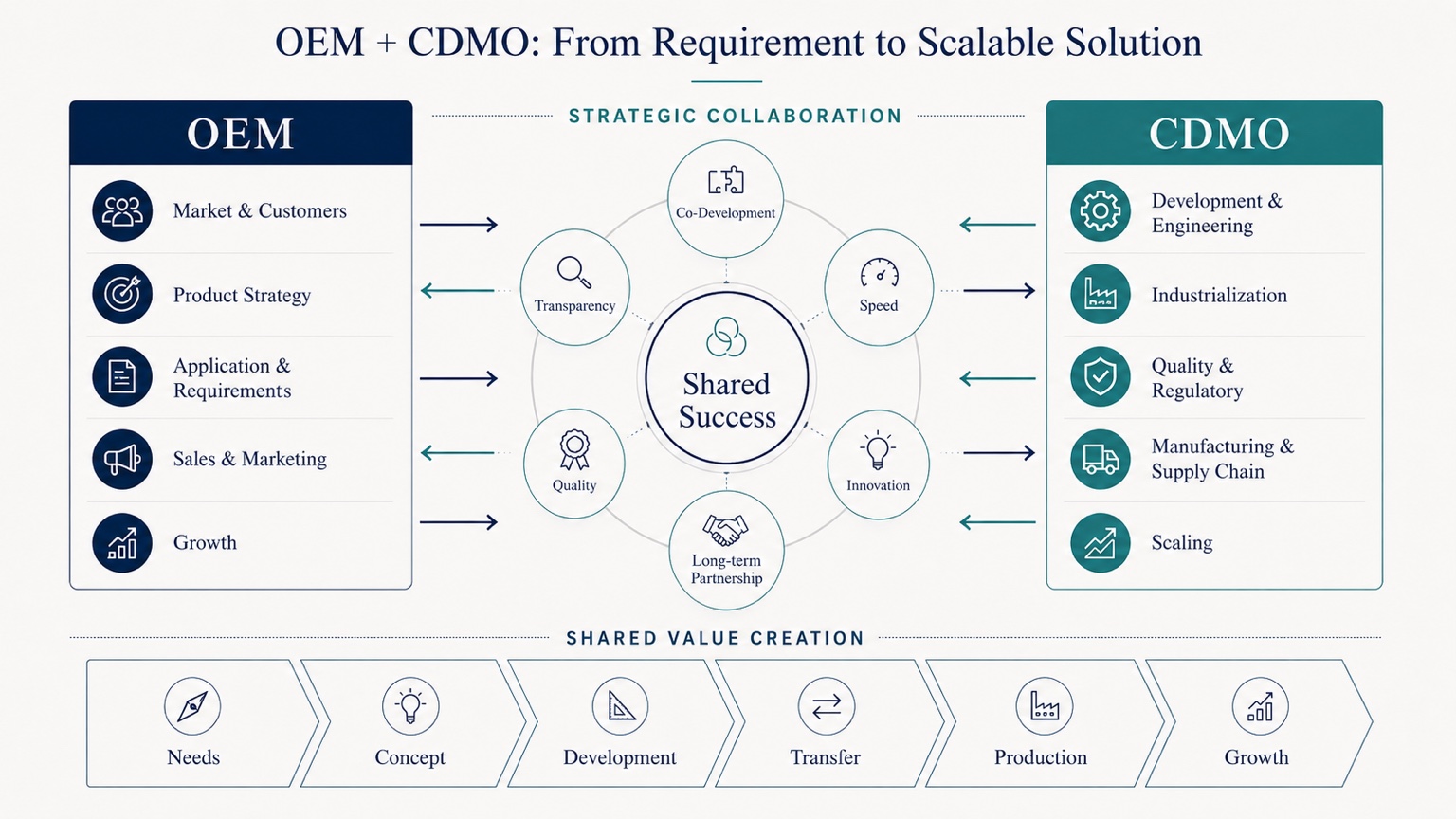
This development is fundamentally changing the role of suppliers in the MedTech industry. The partner of the future will not simply be the company capable of manufacturing a component according to a drawing. Its value will increasingly lie in understanding how a product idea can become a robust and scalable industrial solution.
That requires more than production capacity. It requires the ability to connect product development, design for manufacturing, process validation, quality, regulatory requirements, supply-chain considerations and lifecycle management. In this role, an OEM or CDMO partner becomes part of the customer’s industrialization capability.
Beyond time to market
Time to market remains an important measure. However, speed alone is not enough. A product that reaches the market quickly but cannot be manufactured reliably, scaled economically or supplied consistently has not completed the journey from innovation to sustainable business.
Perhaps we should therefore talk more often about another capability: ability to scale. This means asking early whether a product can move successfully from prototype to validation, from validation to serial production and from initial launch to reliable long-term supply.
Innovation creates attention. Industrialization creates impact.
MedTech needs innovation. But innovation only creates lasting value when it can be translated into a reliable, scalable and economically sustainable medical product.
That is why I believe industrialization should no longer be viewed primarily as an operational step following development. It is a strategic capability—and an increasingly important competitive advantage.
Innovation attracts attention. Industrialization determines whether it becomes a business.