Regulatory requirements are a matter for experienced Regulatory and Quality specialists. From my perspective as a partner to international MedTech OEMs, it is equally important to understand their business implications early. Decisions about products, suppliers, investments and market launches cannot be separated from their regulatory framework.
Regulatory developments change the business environment
The year 2026 offers several examples. In the United States, the FDA's Quality Management System Regulation (QMSR) became effective on 2 February 2026. In Europe, use of the first four EUDAMED modules became mandatory on 28 May 2026. At the same time, the European Commission's proposal for a targeted revision of the MDR and IVDR remains in the legislative process.
I leave the regulatory details to the experts. From my perspective in working with international MedTech OEMs, a different question is decisive: What do these developments mean for business decisions?
Regulatory influences far more than compliance: time to market, product portfolios, development projects, supplier strategies, investments, market access—and ultimately growth.
Commercial opportunities cannot be assessed in isolation
This becomes particularly visible in the collaboration between an OEM and a CDMO. A technically reasonable design change may require additional documentation, testing or validation. A supplier change that initially appears economically attractive can trigger new qualification and evidence requirements. And a promising market or customer opportunity can look different once the full path through development, industrialization, validation and market access is considered.
The earlier the OEM and its development partner assess these connections together, the more reliable timelines, budgets and customer commitments become.
Early dialogue improves decision quality
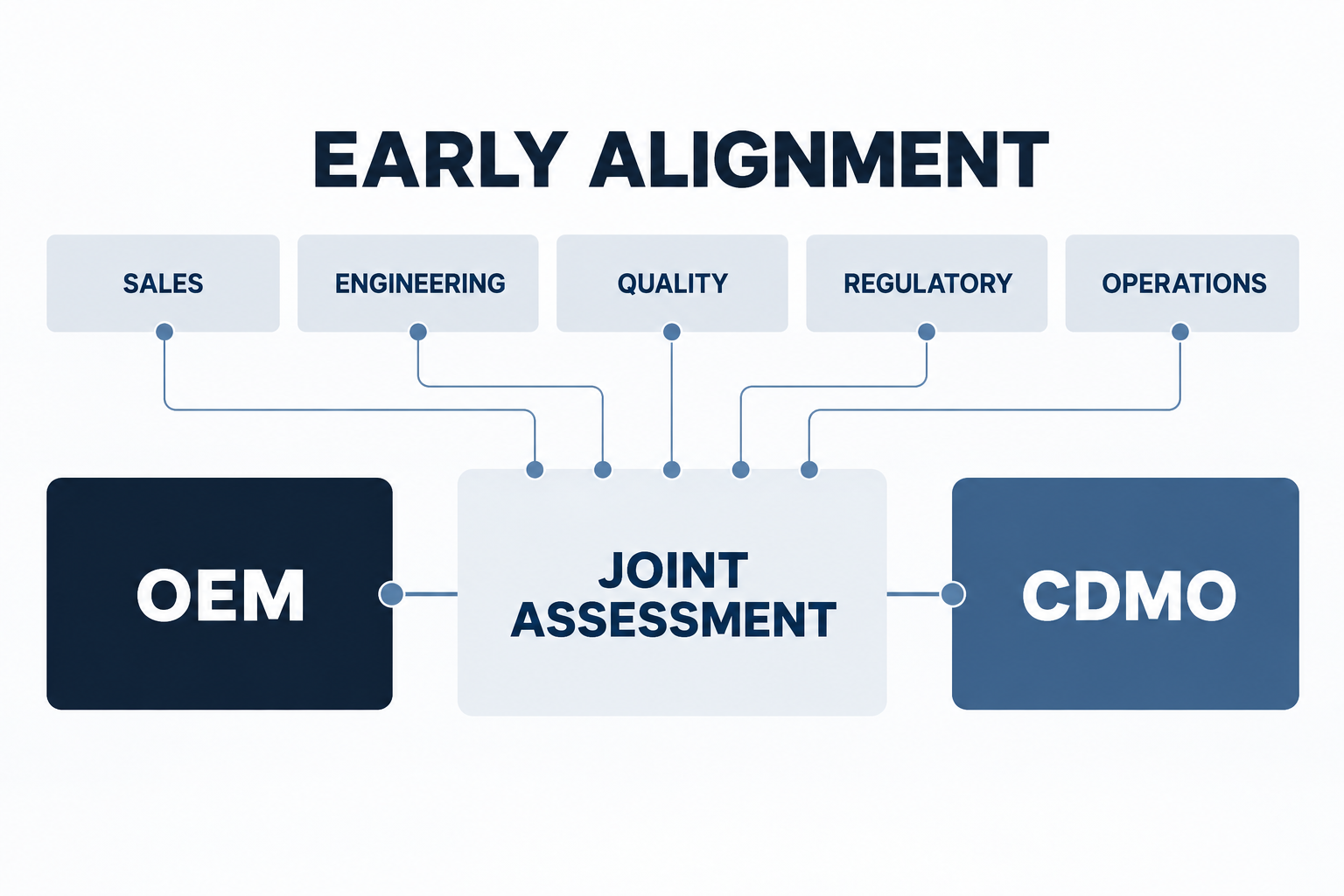
That is why Sales, Business Development, Engineering, Quality and Regulatory need to talk early—on the OEM side as well as within the CDMO. Not everyone has to understand every regulatory detail. But everyone involved should understand the consequences for feasibility, timing, cost and risk.
This shared perspective helps both partners assess opportunities more realistically, evaluate technical alternatives against the full set of requirements and anticipate the consequences of change. It also gives management a more reliable basis for investment and portfolio decisions.
The contribution of a CDMO
A CDMO does not assume the OEM's regulatory product responsibility. An experienced partner can, however, identify early how technical, manufacturing or supply-chain decisions may affect validation, documentation and market access.
That is where its value lies: not treating Regulatory in isolation, but connecting it with development, industrialization and business decisions.
Good regulatory expertise therefore does not slow a project down. It helps the OEM and CDMO define a reliable path to market together.
Regulatory does not belong only in the Quality meeting. It belongs in the strategic alignment between OEM and CDMO.