
Forecasting is comparatively straightforward in an established series business. Historical consumption, known ordering patterns and experience with fluctuations provide a foundation. A New Product Introduction is entirely different.
The OEM’s forecasting dilemma
An OEM may be developing a new medical device or extending an existing system. Instruments or components for the launch are to be developed and manufactured by a CDMO. Long before series production begins, the CDMO needs an indication of the quantities to expect.
This is where the dilemma begins. The OEM is expected to provide a forecast before it can know precisely how the new product will perform in the market. The CDMO, however, needs sufficiently reliable quantities to plan material, capacity and production resources.
At this stage, fundamental uncertainties often remain:
- When will final product approval and the actual launch occur?
- Which markets will launch at what time?
- How quickly will market penetration and system placements develop?
- What quantities are needed for launch, training, samples and initial stocking?
- How will actual consumption develop after launch?
- Which regulatory or commercial factors could delay the ramp-up?
The CDMO needs the number — but must understand its origin
The OEM must forecast quantities before actual consumption data exists. A forecast of 50,000 units in the first full year may be based on a market analysis, planned system placements, Product Management expectations, sales targets or an initial budget assumption. To the CDMO, all 50,000-unit forecasts initially look the same.
Yet a forecast triggers concrete planning processes. Supply Chain Planning & Operations must address several questions early:
- What production capacity will be required?
- Must machine time be reserved or additional capacity created?
- Which raw materials and purchased parts must be available?
- What inventory is required for the planned SOP?
- How will the ramp-up affect existing production programmes?
- Are additional tools, fixtures or investments necessary?
OEM uncertainty meets the CDMO’s need to plan
At the beginning of an NPI, the OEM naturally faces the greatest uncertainty precisely when the CDMO increasingly needs planning confidence. As SOP approaches, the consequences of an incorrect assessment grow.
If the forecast is too low, capacity, material or resources may be missing. If it is too high, unnecessary inventory, reserved capacity or investments may result. During an NPI, a forecast is therefore less a number than a shared assessment of how a series business that does not yet exist may develop.
The Key Account Manager in the middle
This interface changes the role of the Key Account Manager. On one side is the OEM with Product Management, Procurement, Supply Chain and Operations, where the forecast is created under considerable uncertainty. On the other are the CDMO’s own Supply Chain Planning & Operations teams, which must translate this information into material, capacity and production decisions.
The Key Account Manager must be neither a messenger who merely forwards the customer forecast nor an internal advocate for a number whose origins are not understood. The task is to make the assumptions behind the forecast transparent.
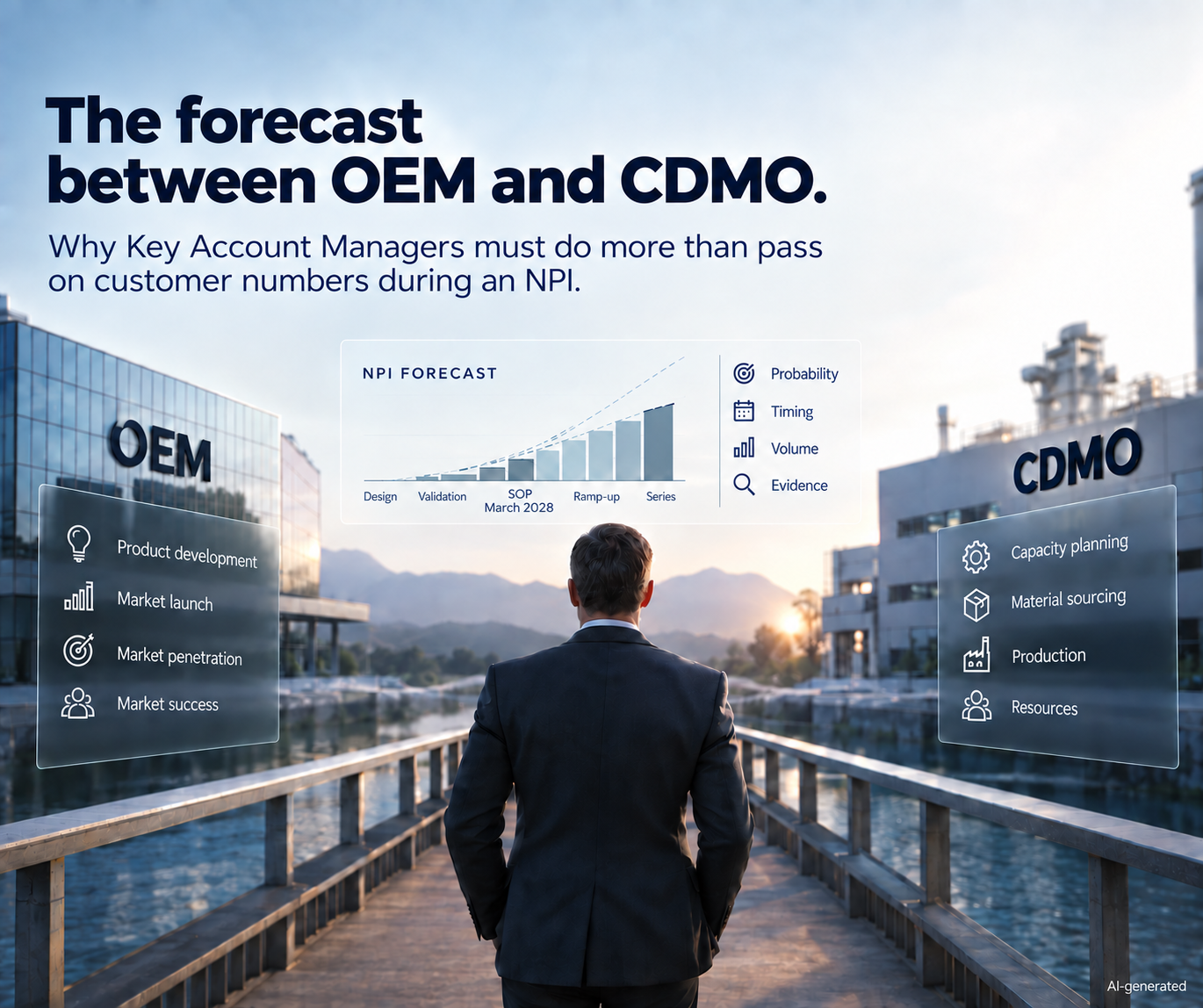
If an OEM plans SOP for March 2028 followed by a specific ramp-up, the Key Account Manager should understand:
- What supports the planned SOP?
- Which milestones still need to be reached?
- Which quantities are relatively reliable and which are planning assumptions?
- How was the ramp-up derived?
- Which markets and product launches underpin it?
- Which changes at the OEM would materially alter the forecast?
A forecast needs context
The Key Account Manager becomes a translator between market assumptions and industrial reality. For an NPI, the number alone is insufficient. The forecast should also show how robust its key assumptions are.
Different scenarios can help:
- Base Case: the currently most likely development
- Upside Case: a faster launch or stronger demand
- Downside Case: delays in SOP, ramp-up or market development
- Probability: How likely is the underlying scenario?
- Timing: When is demand expected to arise?
- Volume: What quantities are expected in each phase?
- Evidence: Which OEM information supports these assumptions?
Deliberate stages instead of false precision
Probabilities can help as long as they do not create false precision. A deliberately simple scale of 0, 25, 50, 75 and 100 percent can be more meaningful than apparently exact scores. The decisive question remains: What evidence justifies the assessment?
A useful NPI forecast is therefore created neither by the OEM nor by the CDMO alone. The OEM has better knowledge of market strategy, product launch, planned system placements and expected demand. The CDMO better understands what different volume scenarios mean for procurement, capacity, production and scale-up. Only when both perspectives are combined does a forecast become workable.
The wrong number is not the greatest risk
NPI forecasts will almost inevitably be wrong. Actual demand will rarely match a forecast made months or years before SOP. That is not evidence of poor forecasting; it is a consequence of the uncertainty inherent in a new product.
The greater problem arises when an uncertain assumption is eventually treated as a fact: an initial customer estimate becomes a forecast, the forecast becomes a production plan, and the production plan becomes a capacity decision. Eventually, the original assumptions behind the number are barely visible.
NPI forecasting should therefore make uncertainty visible and manageable. The Key Account Manager’s task is not to find a perfect number between the OEM and the CDMO’s supply chain. It is to ensure that both sides understand how robust the number is, which assumptions support it and what could change.
During an NPI, planning confidence does not come from false precision. It comes from transparency between OEM and CDMO.